Concrete Slabs in Hamden, CT
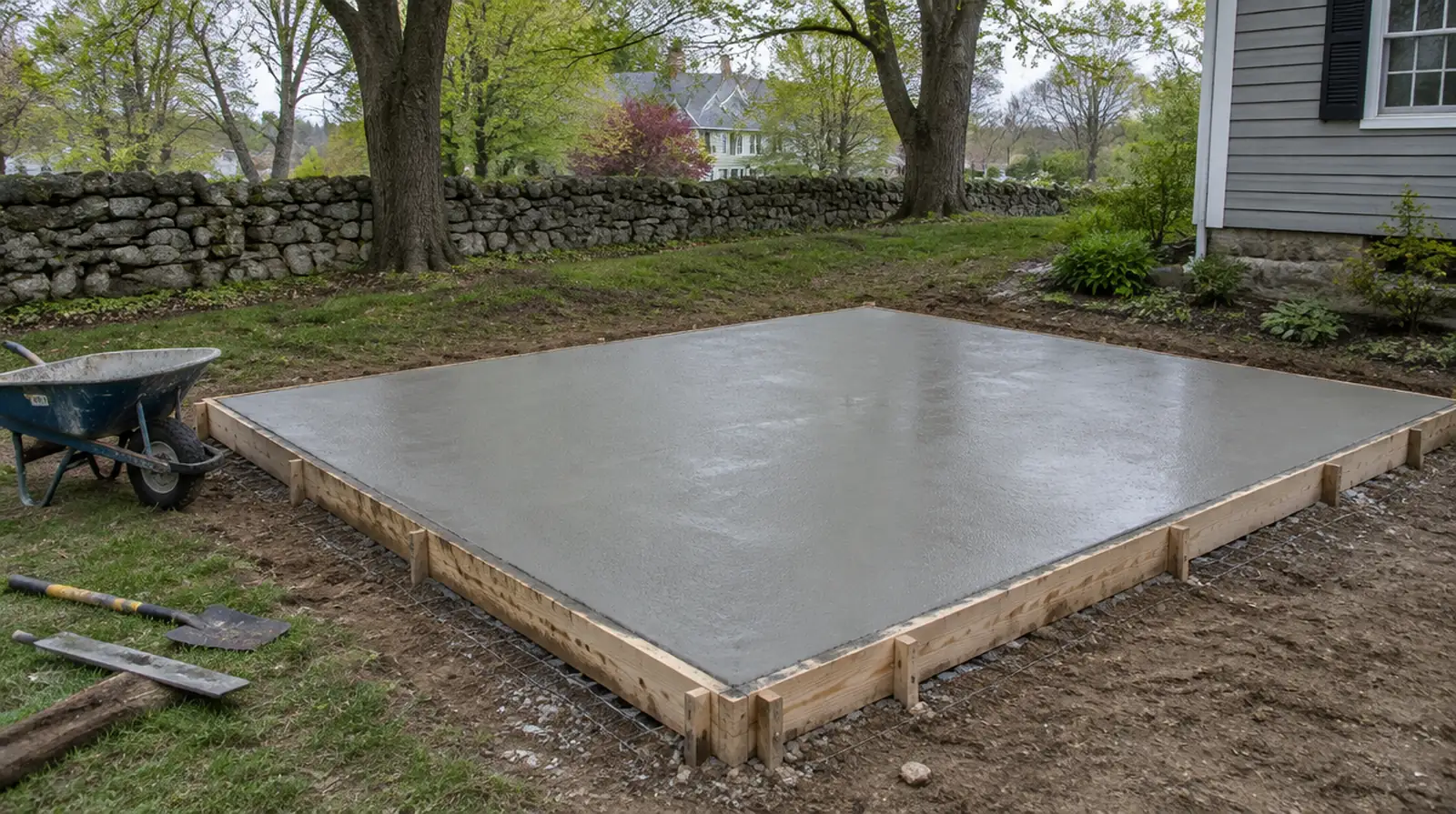
We pour concrete slabs for Hamden homes: new garage floors, basement floor replacements, shed and workshop pads, hot tub bases and pads for heat pumps and generators. Each one starts with digging out to firm ground and building a compacted stone base, because in Hamden the ground under a slab is rarely uniform.
A slab looks simple: a flat piece of concrete on the ground. The difference between one that stays flat for decades and one that cracks across the middle in its second winter is almost entirely below the surface. That is where we spend our time.
What sits under Hamden slabs
Hamden is split between two kinds of ground. In the north end, around Mount Carmel and the streets near Sleeping Giant, there is ledge close to the surface, and an excavator can hit traprock a foot down on one side of a pad and nothing on the other. Toward the south and around the Mill River and Lake Whitney, the soil is glacial till mixed with silt that holds water. Neither is a problem if you plan for it. Mixed bearing is: when half a slab sits on rock and half on soft fill, the soft side settles and the slab snaps along the line.
So we dig every slab out to firm, undisturbed soil, remove organic topsoil and pockets of wet silt, and replace them with crushed stone compacted in layers. Where ledge pokes up, we chip it down or bring the base up around it so the slab has even support everywhere.
Slabs we pour
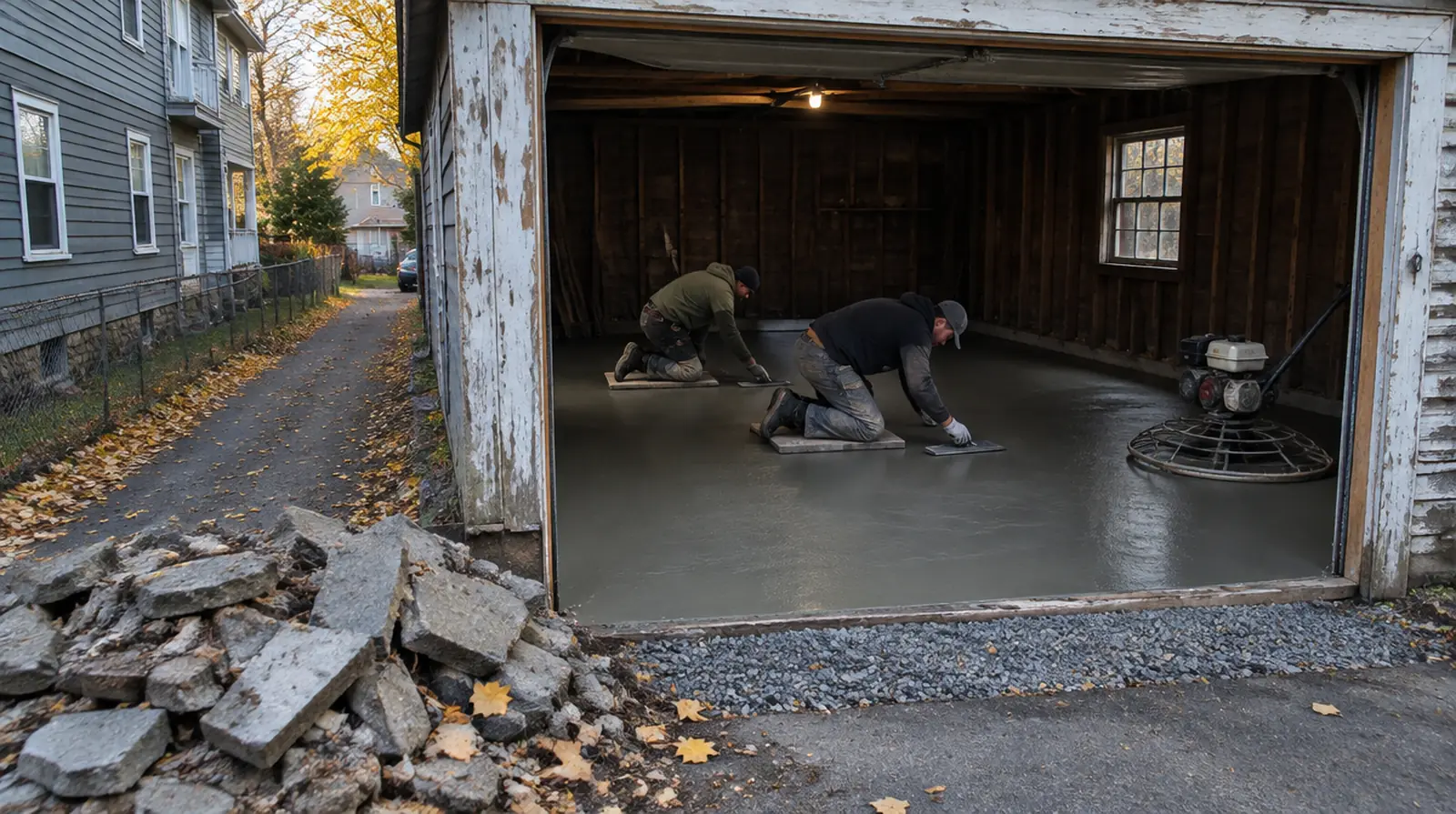
- Garage floors. Many older Hamden garages, especially detached ones behind two-family homes near Whitney and Dixwell Avenues, have floors that are broken, sunken at the door or pitched toward the back wall. We break out the old floor, rebuild the base and pour a new floor that drains toward the door.
- Basement floors. Thin, crumbling basement slabs in older homes can be replaced in sections or whole, with a vapor barrier underneath and room left for a drainage system if you need one.
- Shed and workshop pads. Sized to the building with a small apron so rain off the roof does not undercut the edge.
- Hot tub bases. A filled tub is heavy and concentrated, so these get a thicker section and a dead-level surface.
- Equipment pads. For heat pumps, standby generators and AC condensers, set at the height the installer needs.
Thickness, steel and joints
Most residential slabs are four inches thick. Garage floors and anything carrying a vehicle, a tub or a heavy shed go to five or six, sometimes with thickened edges. We reinforce with welded wire or rebar placed in the middle of the slab on chairs, not lying in the stone where it does nothing. Control joints are cut at regular spacing so the shrinkage cracks every slab wants to make happen in the joints instead of across the middle.
Exterior slabs get air-entrained concrete, which contains tiny air bubbles that give freezing water room to expand. Without it, Connecticut winters and road salt flake the top off within a few seasons.
Slabs and frost
A plain slab on grade does not need footings below the 42-inch frost line, but a slab that supports a structure might. Some garages and three-season rooms need a frost wall or thickened footings at the edges. We sort out which applies before we quote, and if the town needs drawings for a permit, we tell you up front.
How a slab job runs
- Site visit, layout and a written quote.
- Call Before You Dig to mark utilities, plus any permit paperwork.
- Excavation and removal of old concrete or soil.
- Stone base placed and compacted in lifts.
- Forms, vapor barrier where needed and reinforcement.
- Pour, finish and joint cutting.
- Curing: light foot traffic in a day or two, sheds after about a week, vehicles after the concrete gains more strength.
We pour from spring into late fall. In cold snaps we use blankets and adjust the mix so the slab cures properly.
Finishes
Garage and shed floors usually get a smooth steel-trowel finish that is easy to sweep. Outdoor pads get a broom finish for grip when wet. If the slab will be coated later, we leave a surface that accepts it.
Questions about slabs
Can you pour where an old slab was?
Yes. We remove the old concrete and check the base first, because whatever made it fail is usually still there.
Do I need a permit?
It depends on what the slab supports. Plain patios and small pads often do not; garages and some sheds do. We check with the town for your project.
How long before I can use it?
Walking in a day or two, light loads in a week, full strength takes about four weeks.
Planning a slab in Hamden?
Free on-site estimate. Tell us what the slab will hold and we will size the base, thickness and reinforcement to match.
Free slab estimate
Tell us what you need done and we'll get back to you with a price. No charge to look at the job.
Form powered by Splitforms.